Piggy arrived on Roblox on January 23, 2020, about eight weeks before most of the planet was told to stay home. The timing was luck, and the reason it held an audience through two full story arcs, a spin-off, and half a decade of imitators was structure.
MiniToon shipped it as a numbered series rather than as a single game, and each chapter landed with a fresh map, another survivor added to the cast, and a cutscene that refused to answer the question it had just raised. Roblox horror has been running that playbook ever since.
What Is Piggy On Roblox?
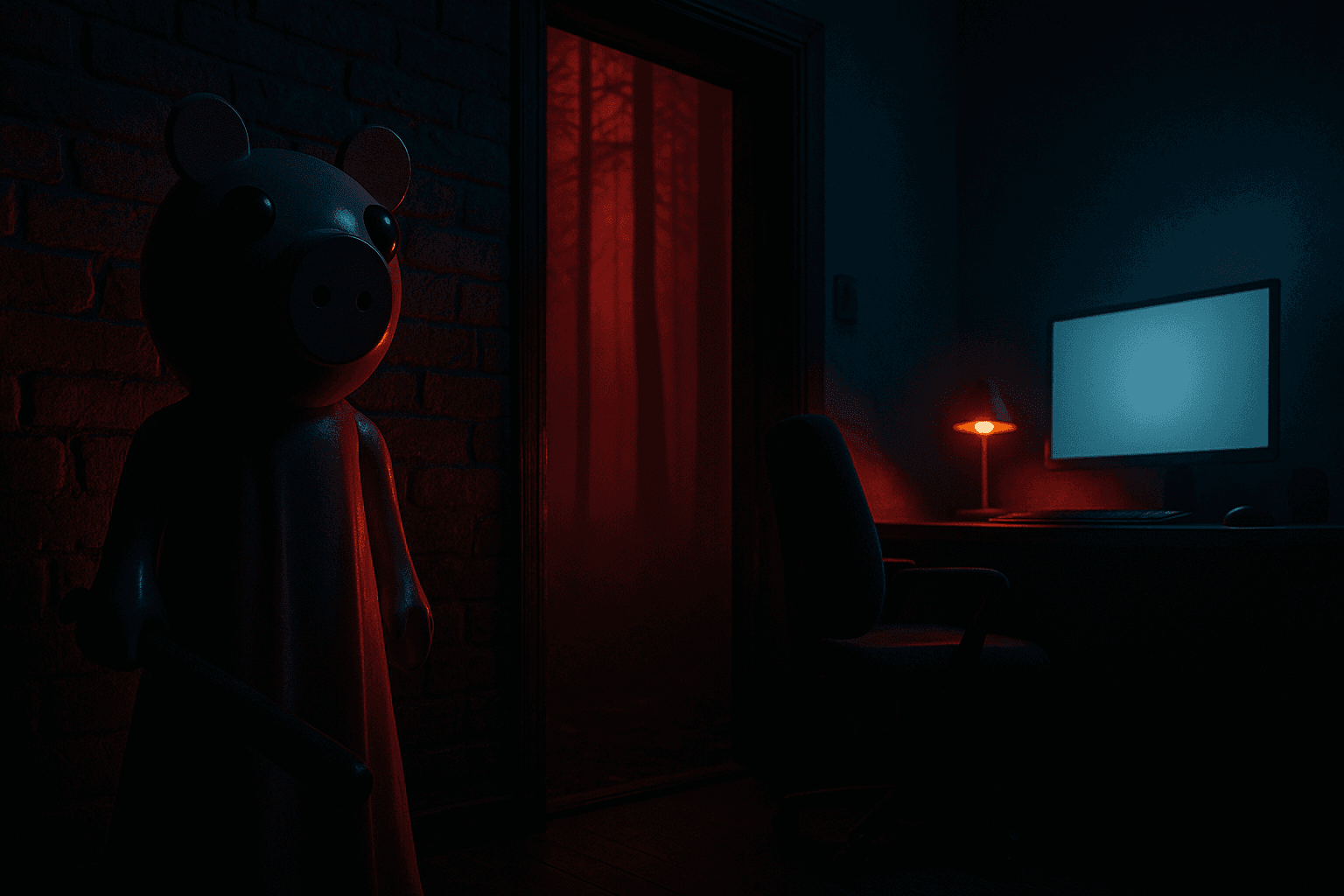
Piggy is a multiplayer survival horror game in which a small group of survivors search a map for scattered items while a bat-wielding hunter closes in. Escape means collecting the right items, using them at the right fixed points, and reaching the exit before the round timer or the hunter ends your run.
Piggy is a Roblox survival horror game from MiniToon, released January 23, 2020. Survivors gather randomly placed items to unlock an exit while a bat-wielding hunter patrols the map, and it shipped in numbered chapters.
The art style borrows the flat, friendly geometry of a preschool cartoon and drops it into pacing lifted from mobile horror hits like Granny. That contrast explains a lot of how fast it spread through elementary-school Roblox servers — the look is disarming, the chase is not.
How The Weekly Chapter Drop Built A Habit
Book 1 ran twelve chapters, from the opening House map through the Plant finale, and they landed on a roughly weekly cadence through the first half of 2020. That schedule did something a single-release horror game cannot do: it converted curiosity into a standing appointment.
Each chapter resolved the immediate escape and then opened a larger question — who Mr. P was, what the infection actually did, why the survivors kept finding the same insignia. Players did not finish a chapter and move on; they finished a chapter and started waiting.
Piggy Book 1 released twelve chapters on a roughly weekly schedule in 2020, each closing on a cutscene cliffhanger. The cadence turned a horror game into an appointment series, and that is the part most copied.
What's more, the weekly rhythm handed YouTube and TikTok creators a guaranteed content beat. A new chapter meant a new escape guide, a new theory video, and a new wave of players arriving mid-story with eleven chapters of backlog waiting for them.
That backlog matters more than the cliffhangers do. A latecomer in month four inherited a finished, playable season instead of a demo, which is the same retention structure we broke down in our Roblox horror game design analysis.
The Loop Underneath: Why Every Map Played Differently
A chapter format only works if the underlying loop can absorb new geometry without new systems. Piggy's can, because the loop is deliberately thin — find items, use them at fixed stations, open the exit, leave.
Items spawn in randomized slots drawn from a fixed candidate pool, so the same map plays differently round to round without the developer authoring anything new. Keys, crowbars, wrenches, gears, and fuses rotate through those slots, and the layout decides how punishing the search becomes.
Piggy herself is the pressure valve, since a hit or two from the bat ends your round and bear traps cover the corridors you would otherwise sprint down. Because the hunter can be a bot or another player, one map produces two completely different difficulty curves.
Add the mode list and a single map becomes several experiences. Player vs Bot is a puzzle race, Player vs Player is a mind game, and Infection turns every death into another hunter working the same halls.
Rotating Maps As A Content Treadmill
Book 1's maps escalate in a specific way, with each one adding a spatial problem the previous map did not have. Here's the shape of that escalation:
| Map stage (Book 1) | What it added | Design job |
|---|---|---|
| House | Small single-floor layout, few item slots | Teach the four-step loop with no punishment |
| Station and Gallery | Verticality and split sightlines | Break the habit of blind sprinting |
| Forest | Open outdoor space with cover instead of walls | Remove corridor safety entirely |
| School and Hospital | Multi-wing floor plans with long dead ends | Make a wrong turn genuinely fatal |
| Metro, Carnival, City | Trains, rides, and street-level set pieces | Vary tempo and add scripted spectacle |
| Mall | Large multi-level commercial space | Stress-test group coordination |
| Outpost and Plant | Endgame maps tied to the story's resolution | Pay off the lore the cutscenes had been drip-feeding |
All of these do the same structural work: they keep the item-hunt loop intact while changing the cost of a mistake. That is the cheapest available way to make familiar mechanics feel new, and it is the trick most later Roblox horror games inherited without crediting.
The pattern worth stealing is simple — change the map's geometry, not the verb list. Piggy's players learned one loop in Chapter 1, then spent eleven chapters re-learning where that loop hurts.
The Lore Drip, And Why Half-Told Worked Better
Piggy's story arrives almost entirely in fragments: chapter-end cutscenes, notes left inside maps, character skins, and endings that shift depending on whether you escaped or died. No single in-game document explains the outbreak, the insignia, or Mr. P's role in any of it.
That gap is the point. Because the game never sat players down for an explanation, the explaining moved outward to theory channels, wiki edits, Discord timelines, and comment threads that argued about chapter ordering for months at a stretch.
Piggy's lore arrives in fragments — cutscenes, in-map notes, character skins, and alternate endings. Nothing explains the outbreak directly, so the community assembled the timeline itself.
Keep in mind that this only pays off when the fragments stay consistent enough to reward the work. Book 2 strained that contract by expanding its cast faster than it resolved anything, and you can watch community theorizing thin out across its run.
The lesson for developers is uncomfortable and real: a mystery that stays roughly seventy percent told generates more free marketing than a mystery that gets answered. Every Roblox horror franchise with an active theory community since 2020 has run some version of this.
Build Mode Turned Players Into Level Designers
Build Mode let players assemble their own Piggy maps from the game's own doors, traps, item slots, and props, then play them with friends. It shipped as a side feature and quietly became a second content engine.
Build Mode lets Piggy players construct maps from the game's own doors, traps, and item pieces, then play them with friends. It filled the dead weeks between official chapter releases with player-made content.
The strategic value is straightforward, because the gaps between chapters got filled by players rather than by the studio. A community that builds for your game is a community that stays inside your game while it waits.
Naturally, this also produced a long tail of derivative maps and a whole generation of Roblox creators who learned horror pacing by rebuilding Piggy's corridors. Several developers now shipping their own chapter-based horror titles came up through exactly that pipeline, which our indie Roblox horror tracker keeps documenting.
The Blueprint In The Wild: What Piggy's Format Became
The clearest evidence that Piggy set a template is how little the games that followed bothered to change it. The naming convention, the episodic release, the cliffhanger cutscene, and the community-decoded lore all recur across the biggest Roblox horror titles of the last five years.
| Game | What it kept from Piggy | What it changed |
|---|---|---|
| The Mimic | Book-and-chapter structure, cutscene cliffhangers, staggered releases | Swapped the item hunt for folklore set pieces and heavier atmosphere |
| Rainbow Friends | Numbered chapters with hard cliffhanger endings, mascot-horror cast | Replaced free-roam searching with scripted, task-driven nights |
| Doors | Episodic content drops, community lore decoding, entity-per-room design | Traded chapters for procedural floors and a run-based structure |
| Apeirophobia | Numbered levels released in batches, escalating map complexity | Dropped the mascot cast for liminal-space environments |
The Mimic kept Piggy's book-and-chapter format outright, Rainbow Friends kept the numbered cliffhanger chapters, and Doors kept the episodic drop cadence while swapping chapters for floors.
Doors is the interesting outlier, since it kept Piggy's release rhythm while abandoning its content model completely. Procedural floors solved the one problem Piggy never solved — what players do after the content runs out — which is why it sits near the top of our ranked best horror Roblox games list today.
Where The Chapter Model Breaks Down
The chapter format has a hard ceiling, and Piggy hit it. A near-weekly release schedule running for months forces the studio to keep authoring bespoke maps, and quality variance shows up quickly once the easy ideas are spent.
Book 2 exposed the second failure mode, because an audience that showed up for a mystery gets restless when the mystery expands instead of resolving. Adding characters is cheap and paying off a plot thread is expensive, so the incentives push the wrong direction.
The bot AI is the third weakness, and it aged the worst of the three. Bot Piggy pathfinds predictably enough that experienced players can loop it around a single pillar more or less forever, which drains the tension out of any map with a central obstacle.
Finally, item RNG can hand one lobby a two-minute escape and the next lobby an unwinnable search. Randomized spawns are what keep maps fresh, and they also mean a real share of rounds are effectively decided before anyone moves.
What Piggy Still Teaches Roblox Horror In 2026
Strip away the pig masks and the lockdown timing, and the design lessons transfer cleanly to any live horror title on the platform. Here's what still holds up:
- Ship a season, not a game. Numbered chapters give latecomers a backlog to binge and give creators a recurring content beat, and those two effects compound on each other.
- Keep the verb list short. Piggy's loop is four actions deep, which is exactly why twelve maps could reuse it without retraining anybody.
- Randomize placement, not rules. Rotating item spawns inside a fixed candidate pool buys replayability at nearly zero authoring cost.
- Let the player be the monster. Player vs Player turns a solved map back into an unsolved one, because human hunters bluff and bots do not.
- Under-explain the story. A partly told mystery converts your audience into your marketing department, provided the fragments stay internally consistent.
- Give the community build tools. Player-made maps cover the release gaps that would otherwise turn into churn.
- Plan the ending before Chapter 1 ships. The chapter model punishes improvised plotting harder than any other format on Roblox.
All of these add up to one point about the platform: Roblox horror rewards serialization more than it rewards scares. Piggy worked that out first, and every franchise since has been paying rent on the discovery.
Frequently Asked Questions About Piggy
Here are the questions that come up most often about Piggy's release history, structure, and current state:
When did Piggy come out on Roblox?
Piggy launched on January 23, 2020, weeks before global lockdowns pushed Roblox traffic to record highs. Book 1 ran twelve chapters through 2020, and Book 2 followed with the same numbered format.
How many chapters does Piggy Book 1 have?
Book 1 runs twelve chapters, from the opening House map through the Plant finale, each with its own layout and ending cutscene. They released on a roughly weekly cadence across 2020.
Is Piggy still worth playing in 2026?
Yes, if you treat it as a co-op puzzle race rather than a scare machine. The maps hold up well, the bot AI is easy to exploit, and Player vs Player mode is where the real tension lives.
Which Roblox horror games copied Piggy's format?
The Mimic copied the book-and-chapter structure directly, Rainbow Friends built on numbered cliffhanger chapters, and Doors kept the episodic drop rhythm while swapping chapters for procedural floors.
What is Build Mode in Piggy?
Build Mode lets players assemble their own Piggy maps from the game's doors, traps, and item pieces, then play them with friends. It filled the gaps between official chapter releases.
Where To Go From Here
If Piggy is your entry point into the genre, the natural next step is seeing how its descendants improved on the formula. Our ranked horror Roblox games guide covers the current field, and the Backrooms Roblox deep dive picks up where the mascot-horror era leaves off.
For everything beyond horror, the full best Roblox games roundup is the wider map. Play a chapter, then go read the theory threads — that combination is the whole reason this genre still has a pulse.