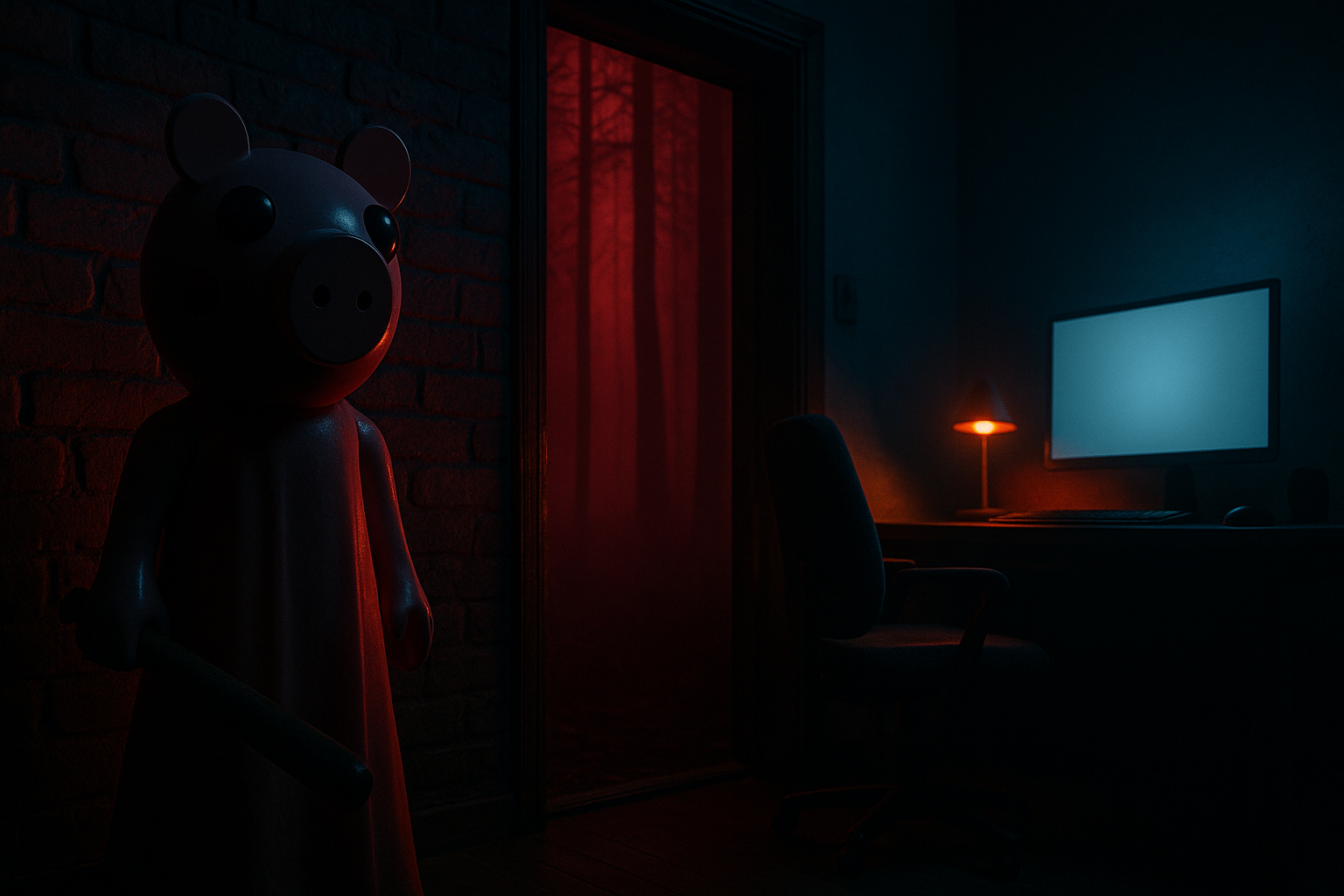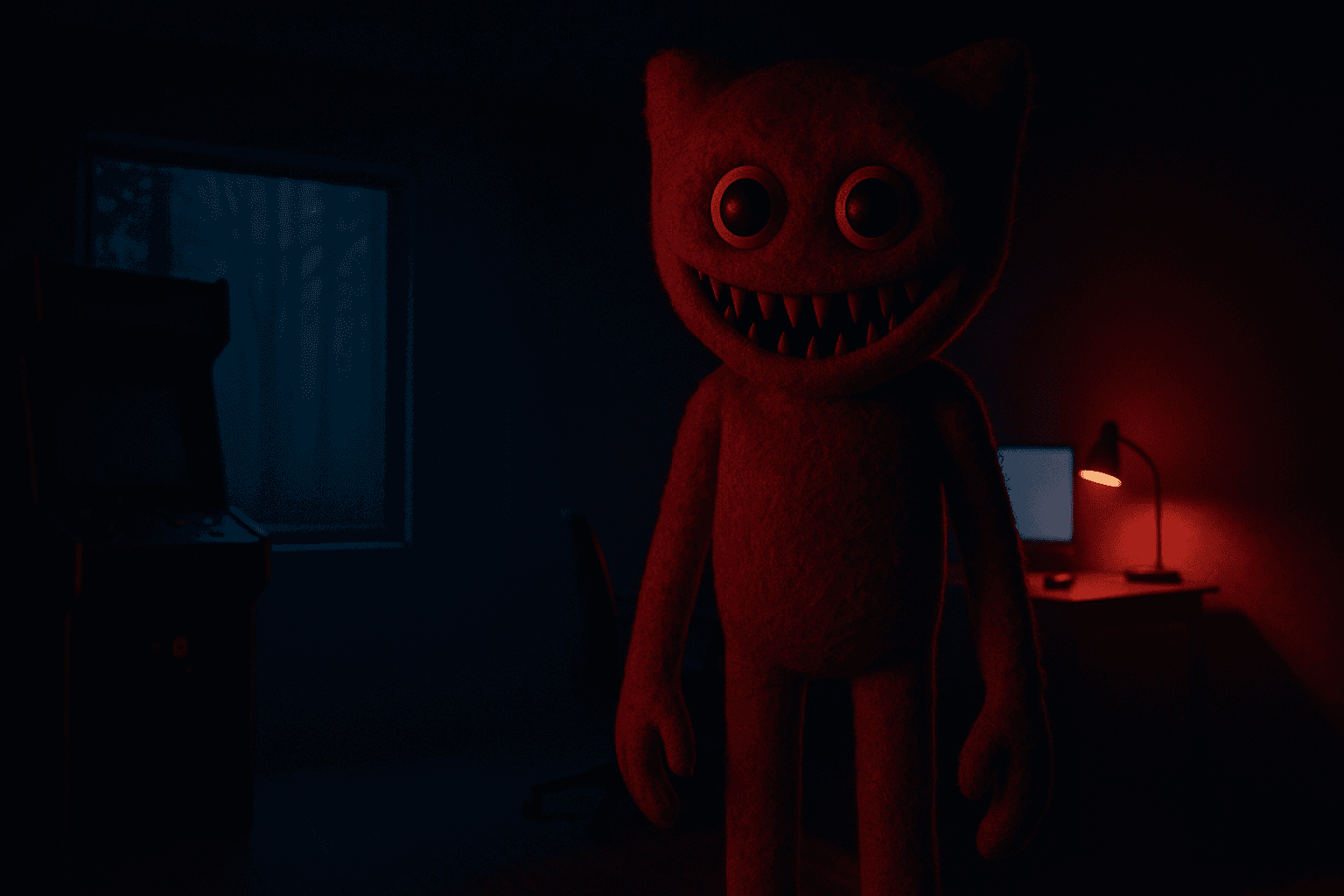
Roblox horror has a new face in 2026, and it is grinning at you. Mascot horror — bright, cartoonish antagonists with friendly proportions and dead, fixed eyes Piggy Roblox mascot horror — has become the platform's fastest-growing scare subgenre, outpacing the folklore and chase formulas best PC horror games that defined the last few years obby genre evolution .
If you have played Rainbow Friends, watched a Poppy Playtime stream, or flinched at a Five Nights at Freddy's animatronic, you already understand the pull on instinct. The harder question is why a smiling, candy-colored creature unsettles players far more reliably than a screen full of blood.
Why do friendly-looking monsters scare players more than gore?
Because a cheerful face that behaves like a predator lands in the uncanny valley, where your brain flags it as wrong but cannot file it as danger. Gore is expected and numbs fast; a smiling hunter never stops feeling wrong.
What Is Mascot Horror, Exactly?
Mascot horror is built on a single, deliberate contradiction: a character designed to look safe, lovable, and marketable is revealed to want you dead. The genre borrows the visual language of theme-park mascots, plush toys, and children's television, then weaponizes it.
The lineage runs straight through Five Nights at Freddy's and Poppy Playtime, and on Roblox it has found a near-perfect home. After all, the platform was already full of blocky, brightly colored avatars, so a hostile cartoon mascot barely looks out of place until it lunges.
What is mascot horror?
Mascot horror is a subgenre built around bright, cartoonish, child-friendly characters — toys, animatronics, mascots — that turn hostile. The fear comes from the gap between how safe they look and what they actually do.
This contradiction is also why the genre travels so well. A jumpscare needs a dark room, but a mascot is frightening in broad daylight, on a bright playground, in primary colors — which is exactly where these games stage their worst moments.
Keep in mind that the "mascot" framing carries the entire mechanism. Strip the friendly shell off one of these creatures and you are left with an ordinary monster that would scare almost no one.
Why A Smiling Face Scares You More Than Blood
To understand the appeal, you have to understand the uncanny valley. The term was coined by the Japanese roboticist Masahiro Mori in 1970 to describe the specific revulsion we feel toward something that is almost familiar, almost human, almost right — and then subtly, horribly wrong.
What is the uncanny valley?
The uncanny valley is the unease we feel toward something almost human or almost familiar but slightly off. Coined by roboticist Masahiro Mori in 1970, it explains why a near-friendly face can read as a threat.
A mascot is engineered to trip every "this is safe" signal your brain has: big eyes, rounded shapes, a permanent smile, soft colors. When that same design moves at you with hostile intent, those safety signals do not switch off — they jam against the threat signal and produce dread instead of clean fear.
Gore works in the opposite direction, and that is exactly why it fades. Blood, wounds, and viscera are honest threats your nervous system was built to read, so it processes them quickly, files them as danger, and then habituates after a few exposures.
Why is a smiling animatronic scarier than gore?
Gore signals danger your brain already understands, so it habituates quickly. A grinning animatronic gives no honest signal, so the threat stays unresolved and the dread keeps building.
This is why a player can wade through a blood-soaked corridor without a flicker, then freeze the instant a smiling bear turns its head. The bear has given the brain nothing to resolve, and an unresolved threat is the one that keeps you awake.
Mascot Horror vs. Folklore And Chase Horror
Roblox horror splits into distinct flavors, and mascot horror only makes sense next to the two formulas it is overtaking. Folklore horror, like The Mimic, scares you with cultural dread and slow-burn story, while chase horror, like Doors, scares you with pursuit and timing.
The table below breaks down how the three fear mechanisms actually differ. For a wider survey of what is live right now, our roundup of the best horror Roblox games covers all three styles in one place.
| Subgenre | Example | Core fear mechanism | What triggers the dread | How the fear fades |
|---|---|---|---|---|
| Folklore horror | The Mimic | Cultural dread and story | Myth, lore, and the unknown | Once the story is fully known |
| Chase horror | Doors | Pursuit and timing | Sudden pursuit and jumpscares | Once you learn the patterns |
| Mascot horror | Rainbow Friends | Uncanny valley betrayal | A friendly design that turns hostile | Slowly, if ever — the wrongness lingers |
How is mascot horror different from chase horror?
Chase horror like Doors scares you with sudden pursuit and jumpscares you can learn to predict. Mascot horror scares you before anything moves, using a friendly design your brain refuses to trust.
Notice that folklore and chase horror both have an expiration date, because knowledge eventually disarms them. Mascot horror is stickier precisely because no amount of knowing makes the smiling face feel right.
Why Mascot Horror Took Over Roblox In 2026
The subgenre exploded for concrete reasons, and Roblox is almost custom-built to host it. Several forces stacked up at once, and together they explain why mascot horror is the trend of the year.
Here are the main reasons the format fits the platform so well:
- The art style does the work for free. Roblox's blocky, saturated, low-poly look renders cute mascots flawlessly, so developers get a friendly shell at zero cost and only have to supply the menace.
- The audience already trusts mascots. A large share of Roblox players grew up on Five Nights at Freddy's and theme-park characters, so the betrayal of a trusted mascot lands harder than a generic monster ever could.
- The clips are made for short video. A two-second shot of a smiling creature lunging is perfect TikTok and YouTube Shorts fuel, and that free distribution feeds new players straight back into the games.
- Multiplayer raises the stakes. Many mascot games are co-op, so the dread is social — you watch a friendly-looking thing drag a friend off screen while you are powerless to stop it.
Why is mascot horror growing on Roblox in 2026?
Roblox's blocky, cartoon-friendly art style renders cute mascots perfectly, the young audience already trusts mascot characters, and short betrayal clips spread fast on TikTok and YouTube.
Of course, virality compounds all of this. Each clip that goes viral pulls in a fresh wave of players, who record their own reactions, which feed the next wave — a loop that rewards the most unsettling design rather than the most graphic.
What's more, the format is cheap and fast to build, which matters on a platform driven by independent creators. If you want to see how these tense, claustrophobic loops are constructed under the hood, our breakdown of what makes horror game design work walks through the mechanics in detail.
The Design Tricks That Manufacture Dread
Good mascot horror runs on a small toolkit of tricks applied with discipline. Once you know what to look for, you can feel the developer pulling each lever.
The most common techniques include but are not limited to the following:
- Friendly proportions, predatory behavior. The creature keeps its plush silhouette and oversized eyes even as it sprints, and that mismatch between shape and intent is the core of the scare.
- Broken or stiff animation. Movement that is slightly too smooth, too jerky, or too fast pushes the design deeper into the uncanny valley, where your brain insists something is wrong.
- Nursery-rhyme audio. Music boxes, giggles, and sing-song voices borrow the soundscape of childhood safety, so the audio itself becomes a threat cue over time.
- The betrayed safe space. The friendliest, brightest, most welcoming room is usually the trap, which teaches players that comfort is the warning sign.
- The delayed reveal. The mascot is shown smiling and harmless long before it attacks, so dread compounds while you wait for the inevitable turn.
Notice how few of these rely on blood or graphic violence. The genre's power comes from contrast and anticipation rather than from what it shows you.
What This Means If You Actually Want To Survive
Understanding the fear mechanism is also the first step to beating it. Because mascot horror works by jamming your instincts, the counter is to stop trusting the friendly cues and start reading the systems underneath.
A few practical habits help a lot:
- Treat calm as a warning. If a room feels unusually safe and inviting, slow down and check your exits before you commit to it.
- Learn the audio tells. Most mascots telegraph their approach with footsteps, a giggle, or a musical sting, so train your ears before your eyes.
- Memorize patrol patterns. Like chase horror, mascot creatures usually follow routes, and predictable routes can be timed and avoided.
For broader survival fundamentals that carry across the whole category, our guides on the best survival Roblox games and the latest entries on the indie horror tracker are good next stops. The same calm-reading instincts transfer cleanly from one mascot game to the next.
The bottom line: mascot horror scares you by turning safety itself into the threat, and that is a fear no amount of gore can match. Once you stop trusting the smile, you start surviving the game.
Frequently Asked Questions
Is mascot horror only for kids on Roblox?
No. While many mascot horror games use a child-friendly art style, their tension and jumpscares are aimed at teens and adults who grew up on Five Nights at Freddy's. The cute shell is the bait, not the audience.
What are examples of mascot horror on Roblox?
Rainbow Friends is the clearest Roblox example, with brightly colored creatures that hunt you. The style draws on Poppy Playtime's Huggy Wuggy and the Five Nights at Freddy's animatronics that inspired the subgenre.
Is mascot horror scarier than chase horror like Doors?
It scares differently. Doors builds dread through pursuit and timing you can eventually learn, while mascot horror unsettles you on sight, so the fear arrives before the chase even starts.
Why does the uncanny valley make cute characters frightening?
The uncanny valley is the discomfort we feel toward something nearly familiar but subtly wrong. A mascot with a fixed smile and dead eyes lands in that gap, so your brain treats the friendly face as a hidden threat.
How do I stop getting jumpscared in mascot horror games?
Learn each mascot's patrol pattern and audio cue, since most telegraph their approach with footsteps or a musical sting. Treat any unnaturally calm, friendly area as a setup and keep your exit route in mind.
Mascot horror is still early in its run, and developers are only getting better at the contrast that powers it. If the trend holds, the scariest thing on Roblox in 2026 will keep smiling right up until the moment it catches you.